Trip Report: Athens and a Mediterranean Cruise
Lounge Reviews: The Club CLT and Centurion Lounge Charlotte Airport
Flight Review: Lufthansa A340-600 Charlotte-Munich
Lodging Review: Academias Hotel, Autograph Collection, Athens
Our Time in Athens, Part I (Acropolis and Museum)
Our Time in Athens, Part II (Roman Agora, Hadrian’s Library, Ancient Agora)
Our Time in Athens, Part III (Kerameikos, Temple of Zeus, Panathenaic Stadium)
Our Time in Athens, Part IV (Restaurants and Observations)
Ship Review: Viking Neptune
Our Time in Ancient Olympia (Katakalon, Greece)
Our Time in Corfu, Greece
Our Time in Kotor, Montenegro
Our Time in Dubrovnik, Croatia
Our Time in Zadar, Croatia
Our Time in Venice, Italy
Flight Review: Iberia A330-300 Madrid-Chicago
It had been 16 years since my only visit to Athens and my friend had never been. As we were trying to figure out what we wanted to see, I stumbled upon the Earth Trekkers site and their post “2 Days in Athens: The Perfect Itinerary for your First Visit“. That post not only gave us a good idea of highlights to hit but it also introduced us to the combo ticket that gets you into 7 sites for just €30. Those seven sites are:
The Acropolis
Ancient Agora (Archaeological site and Museum)
Roman Agora
Hadrian’s Library
Kerameikos
Temple of Olympian Zeus (called Olympieion on the ticket)
Aristotle’s Lyceum
That’s quite a bargain once you add up the admission prices of all these sites. We recommend buying your combo ticket online in advance.
We hit the first four sites plus the Acropolis Museum the first day and sites 5 and 6 plus the Panathenaic Stadium on the second day. We didn’t make it to Aristotle’s Lyceum but after walking 27,000 steps the first day and another 20,000 steps the second day we were OK with that as we were exhausted.
Monument of the Unknown Soldier
Our day started quite early as our timed ticket for the Acropolis gave us entry at 8 AM. So we left our hotel about 7:20 to give ourselves plenty of time for the walk and to get lost. Our path took us by the Monument of the Unknown Soldier which is on the road that travels over the Syntagma Square Metro station. We weren’t there for the changing of the guard but the two soldiers were marching back and forth under the watchful eye of their superior. We paused for just a few moments and realized it was a great time to be able to get photos without any other people around.


The Acropolis
We reached the entry to the Acropolis in plenty of time and had to wait in line for about 10 minutes before the site opened and we began our trek up the hill over a combination of inclined walkways and steps. Unfortunately, if you are mobility-challenged this is not going to be a good place to visit as very little is wheelchair or scooter-accessible. We lucked out in that there was a bit of a cloud cover during our visit which kept us from overheating as it was quite warm, even in October. We highly suggest you bring water with you as well as sunscreen and a hat or other type of sun shade as there is no shade on top of the hill and only tiny pockets of shade on the paths to and from the top.
Theater of Dionsyus Eleuthereus
This is where theater began both as an art form and as an architecture. Like many ancient Greek structures it dates to the mid-5th century BC. It began as a wooden structure and was in the process of being converted to a stone structure when the Peloponnesian War broke out in the latter half of the 5th century BC. Eventually the structure was completed and it is estimated to have a capacity of 17,000-19,000 spectators. In the early 2nd century AD the Emperor Hadrian had it assume a new role, hosting his celebrations in addition to the plays and concerts it previously hosted. It suffered damage during raids in the 3rd century, was repaired in the 4th century but by the 6th century an edict had been issued which banned pagan religions and that marked the end of theater’s use.
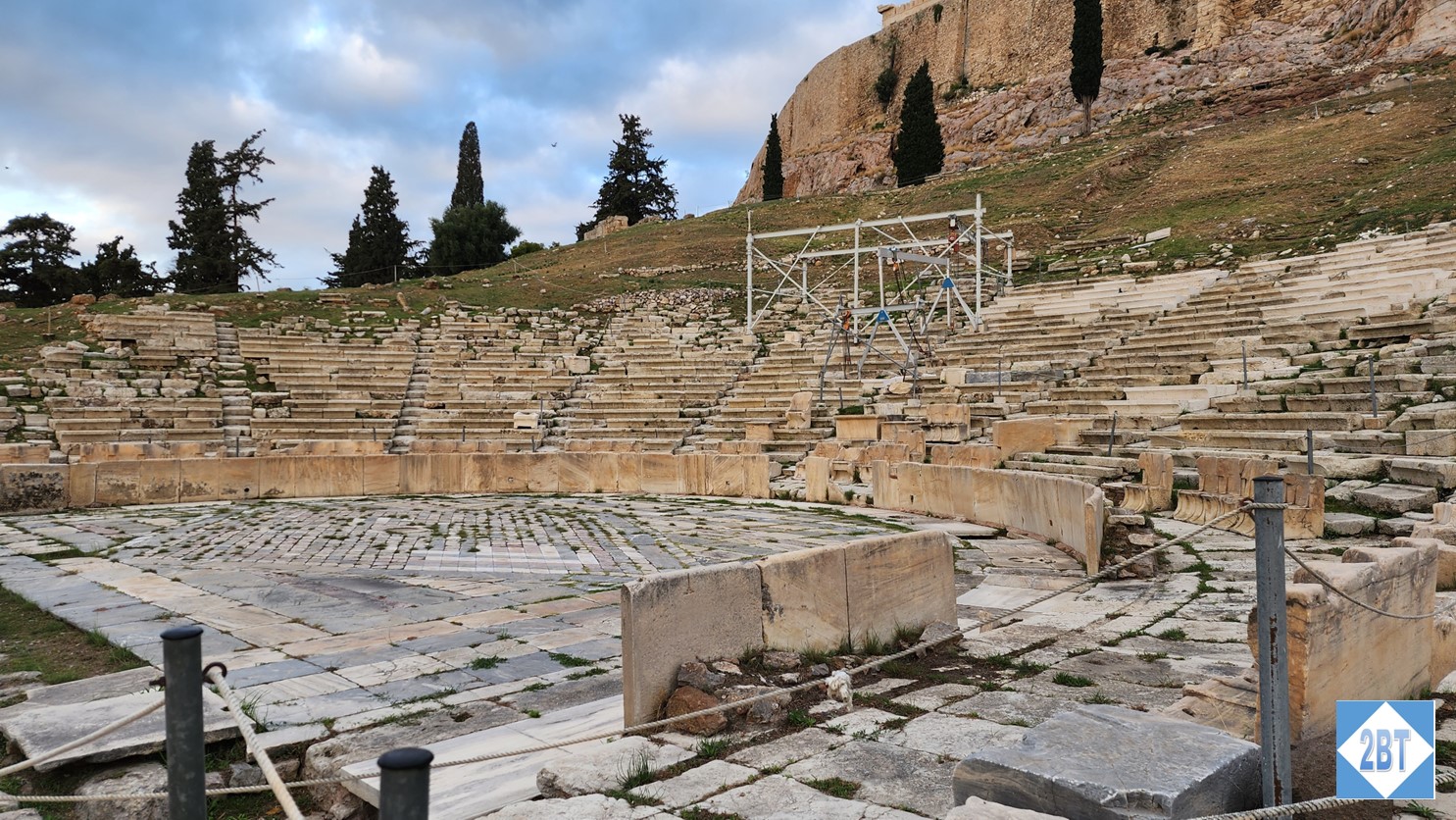
Theater of Dionysus
Sanctuary of Asklepios
We passed by this structure which was a healing center, dedicated to Asklepios, the god of medicine. According to the Acropolis museum’s site: It included a temple with the god’s cult statue; an altar; a sacred spring; an offering pit and two stoas. One served as a dining hall for priests and visitors; the other as a enkoimeterion or abaton – where patients spent the night, believing that Asklepios would visit them in their dreams and miraculously cure them, or give them healing advice.
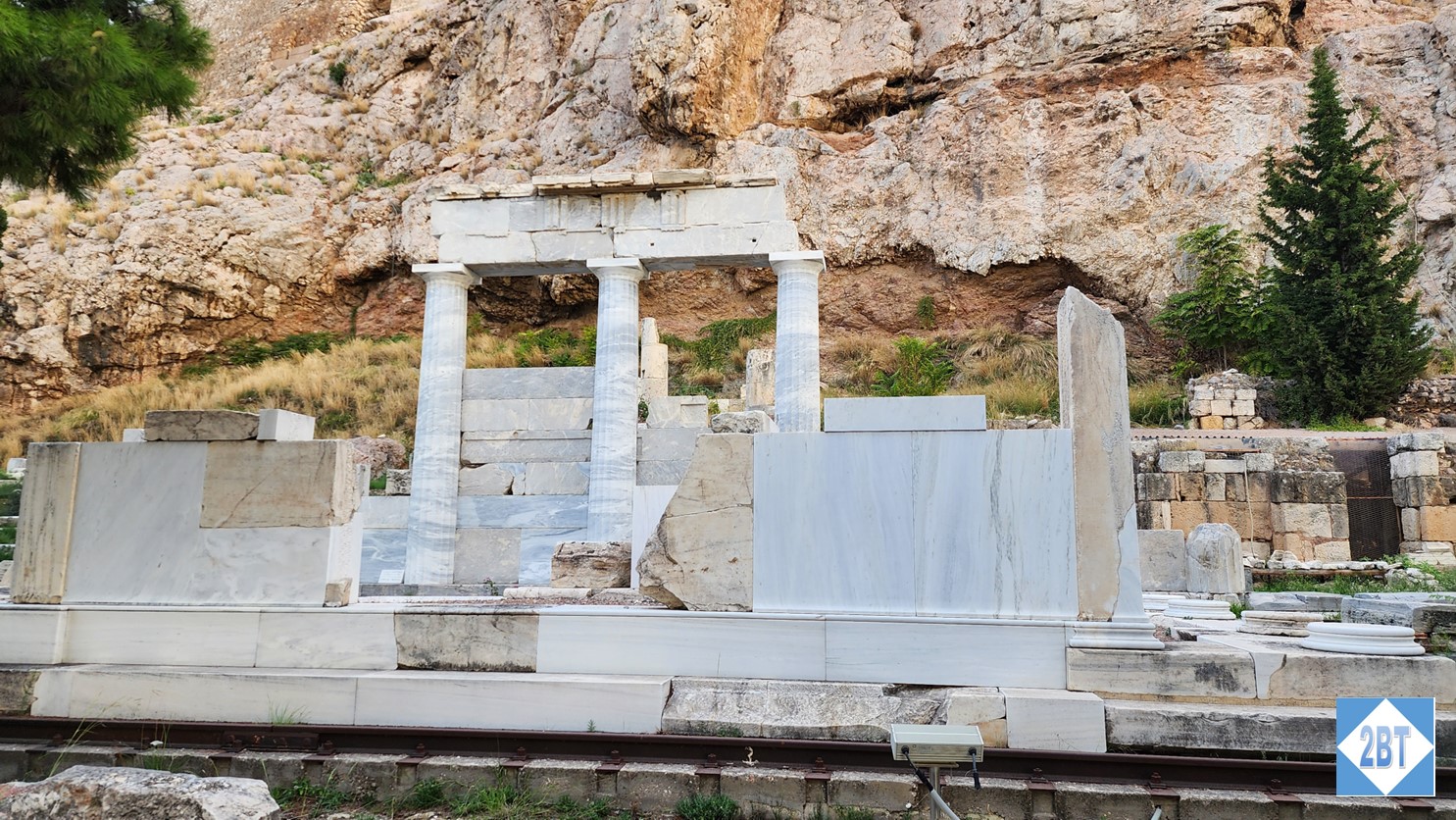
Sanctuary of Asklepios
The View on the Way Up
We paused on the path to take in some of the gorgeous view as the sun started peeking through the cloud over various parts of the city.

Gorgeous City View on the Climb Up
The Odeon of Herodes Atticus
Also known as the Herodeion, this Roman theater is “new” by comparison to the Dionysian one, being built in 161 AD by the Greek senator for whom it is named. He was a great philanthropist and built this theater in memory of his Roman wife. The theater is made of stone and it originally had a wooden roof made of the expensive timber from Lebanon. It was left in ruins during attacks in AD 267. The audience seats and the stage were restored in the mid-1950s and each in May through October it hosts performances as part of the Athens Festival.

The Herodeion
The Propylea
The gateway to the Acropolis is called the Propylea (pro-pil-LAY-uh) and it was built 437-432 BC. As I compare my photos to the ones from my prior visit in 2007 I note that the wooden stairs in the lower part of the entrance are not new so maybe it hasn’t changed as much as I’d thought. I recalled that once the top of the stairs was reached that it was on to the natural uneven, and sometimes slippery, surface. Once you’ve reached the main level the wooden walkway continues on until you’re through the ruin of the propylea and the main path is much more level.

The Propylea
The Temple of Athena Nike
This temple, dedicated to the goddesses Athena and Nike, is just to your right as you’re climbing up to the propylea. It was built around 420 BC. While it is restored somewhat on the outside, this is about as close as you can get to it.
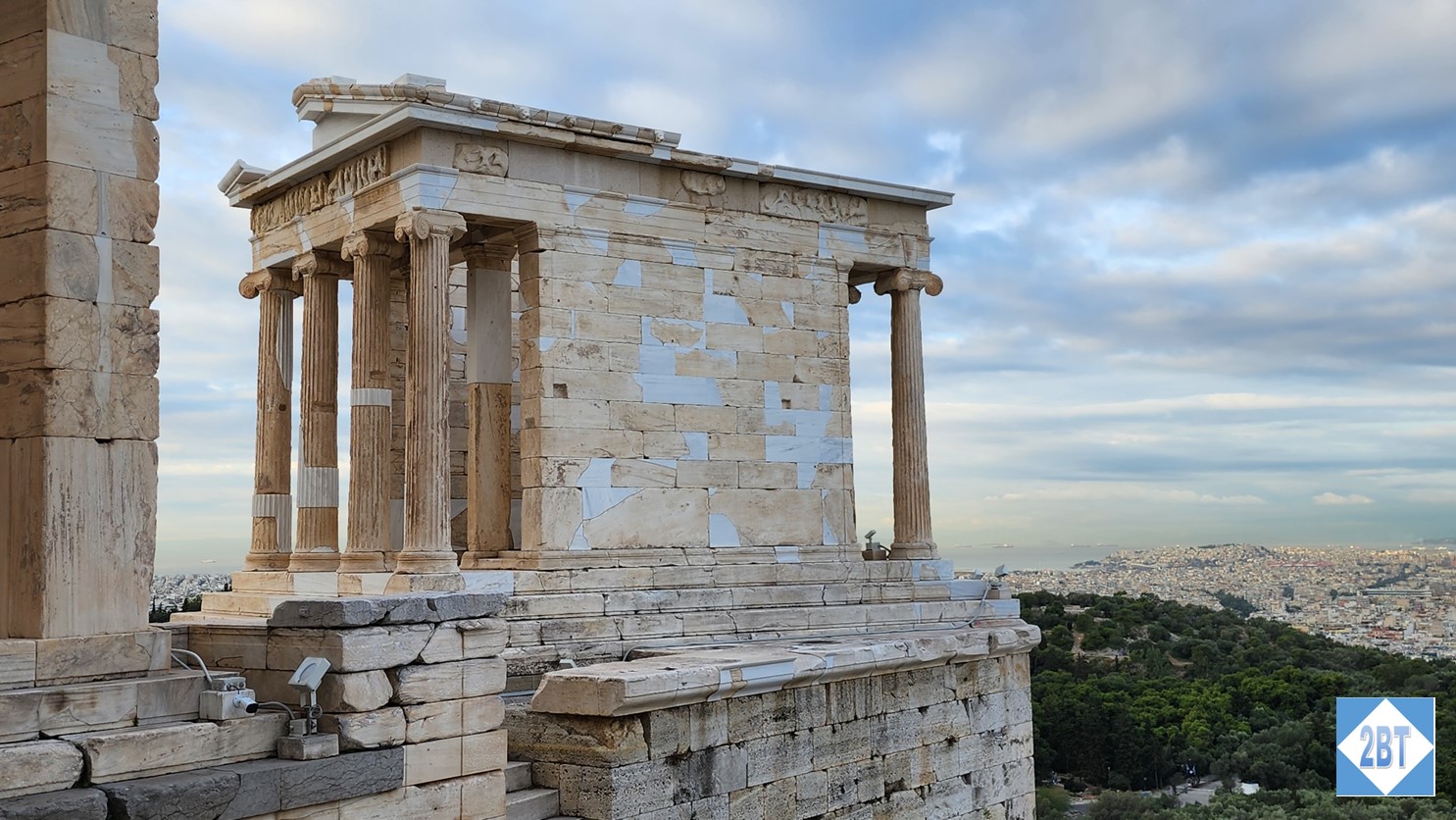
Temple of Athena Nike
The Parthenon
Once through the propylea just ahead to your right is the Parthenon. Having grown up in Nashville, where there’s a full-sized replica, I’ve always been aware of this temple but it’s something else to see the remains in person. It’s had so many uses throughout its existence! Built as a temple to the goddess Athena from 447-438 BC, it later became the treasury for the Athenian Empire and, in the 6th century AD, it was converted to a Christian church dedicated to the Virgin Mary. When the Ottomans conquered the area in the mid-15th century they converted the church into a mosque. Later it was used it as a munitions depot which was unfortunate because a Venetian bomb landed on it in 1687. And of course in the early 19th century Lord Elgin took down some of the surviving sculptures and those remain in the British Museum.
The building had seventeen columns on the side and eight on either end. There are also rows of six columns further inside at each end. The columns are actually very slightly (just over 1.5 inches) wider in the middle than at the ends. This causes the optical illusion that they are actually completely straight when viewed from a distance.
There is very little left in place of the original pediments, which are the parts under the angled portions above the columns. The rest are in the Acropolis Museum, which we visited later, and the British Museum.
There are also a few metopes still in place. These were rectangles carved in high relief. There were 14 on each end and 32 along each side of the building. They illustrated mythical battles and for this reason many of the metopes on three sides of the building had been deliberately mutilated during the prosecution of pagans during the reign of Constantine. The Acropolis museum has many of the ones that have been taken down and there are more in the British Museum and one in the Louvre.
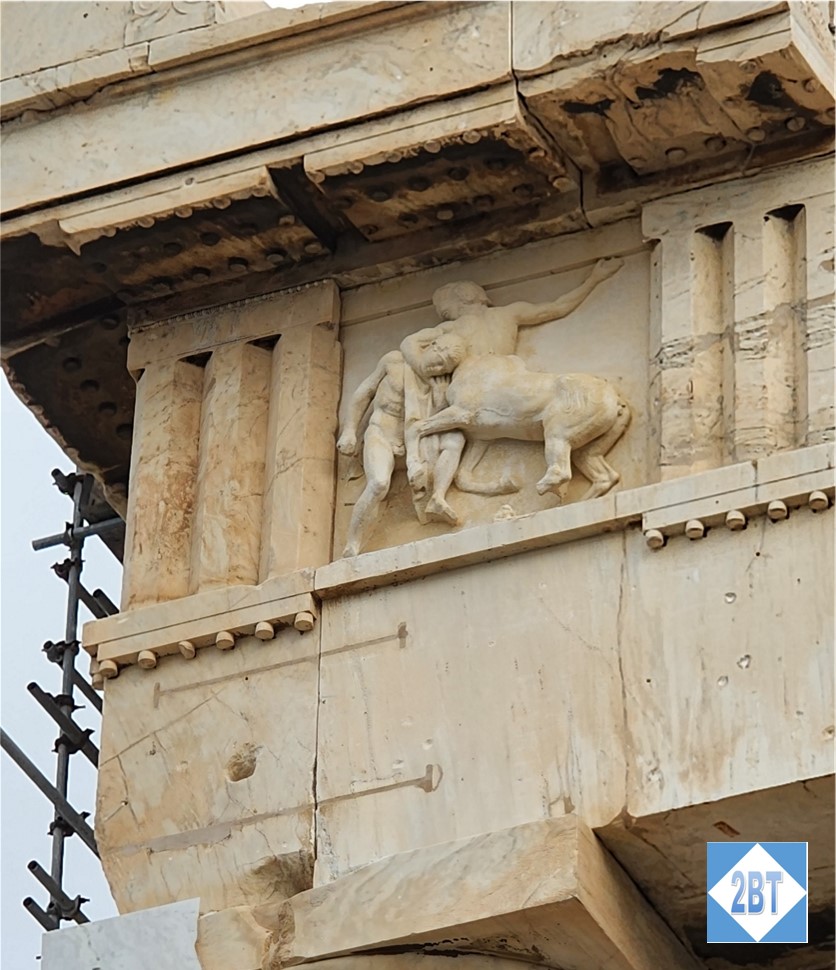
A Metope still in place
The Erechtheion
This is another temple dedicated to Athena. It is likely best-known for the Caryatid Porch, or Porch of the Maidens, where the pillars of the porch are statues of young women. The pillars in place today are reproductions but we did see the originals in the Acropolis Museum. This temple is slightly younger, with estimated building dates from 421-406 BC.


The View From the Top
There’s a viewing platform at one end of the Acropolis which offers some pretty spectacular views of other sites in the city:
Mount Lycabettus aka Lycabettus Hill
This is the highest point in Athens at 908 feet above sea level. There is a large open-air amphitheater at the top.
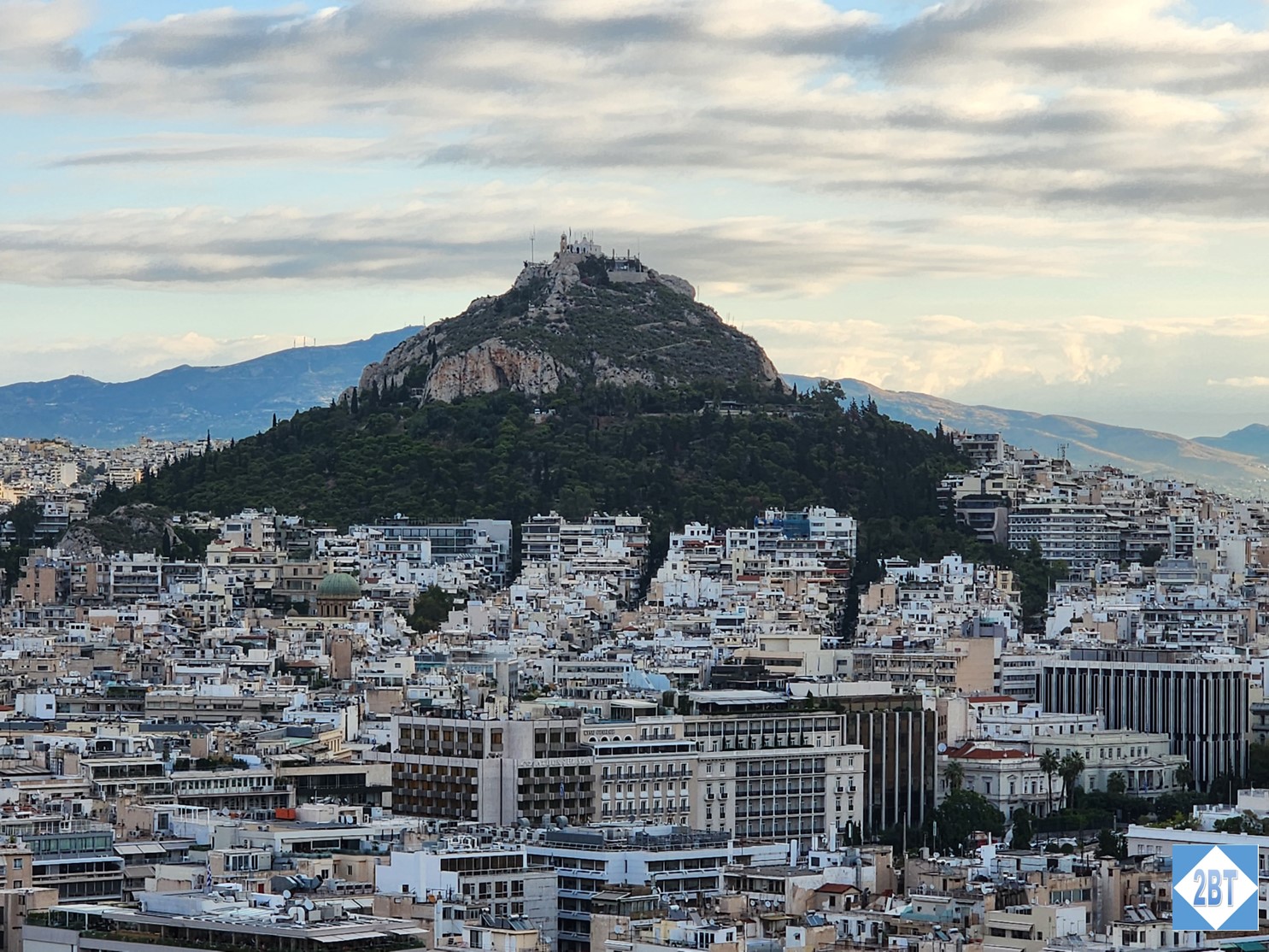
Lycabettus Hill
Temple of Hephaestus
This is a temple dedicated to the patron god of metal working, craftsmanship and fire. We’d visit it up close as part of the Ancient Agora complex.
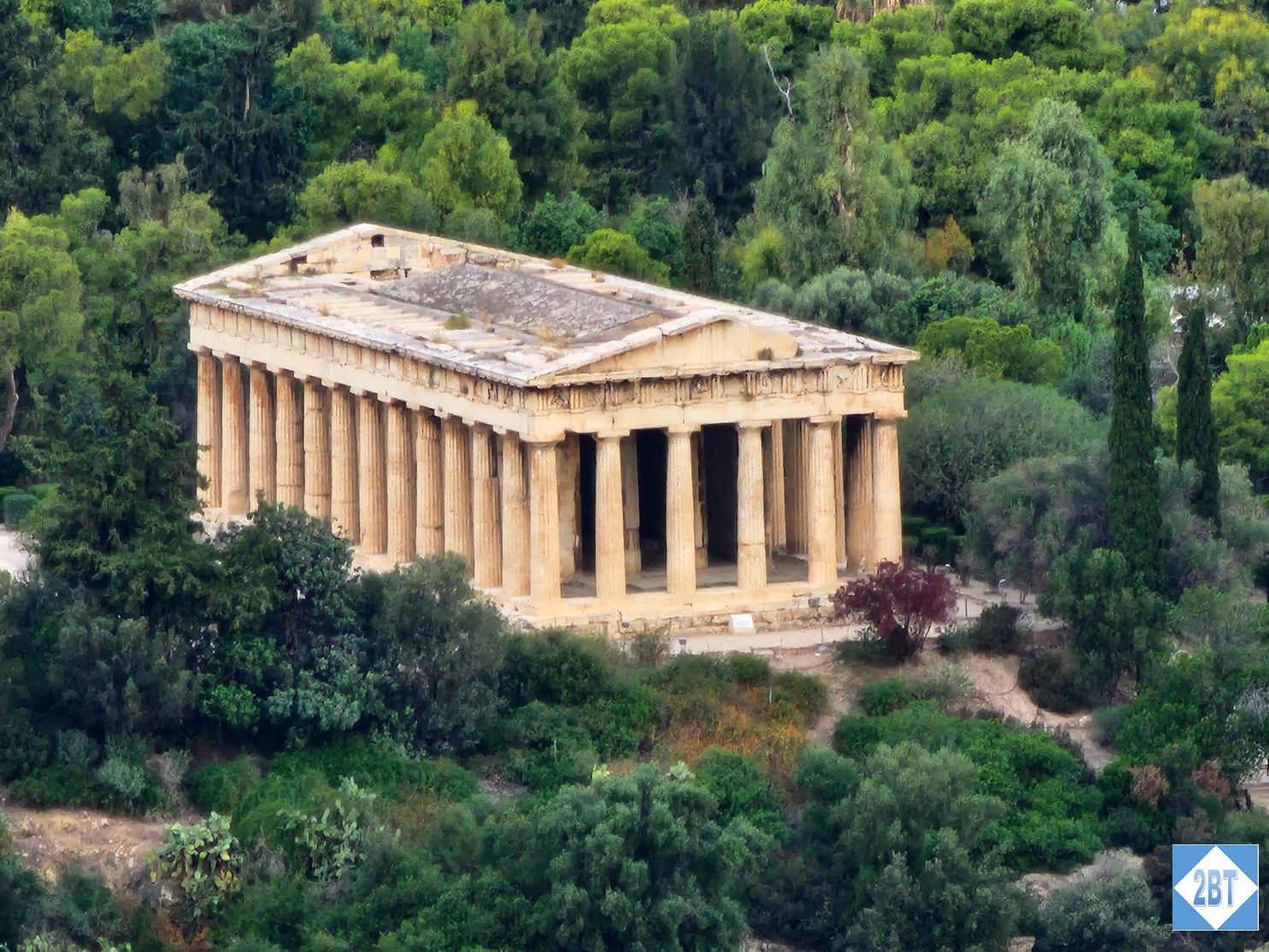
Temple of Hephaestus
Temple of Olympian Zeus and Hadrian’s Arch
We’d actually walked past this site on our way to the Acropolis. As this was one of the sites available on our combo ticket, we’d visit it later.
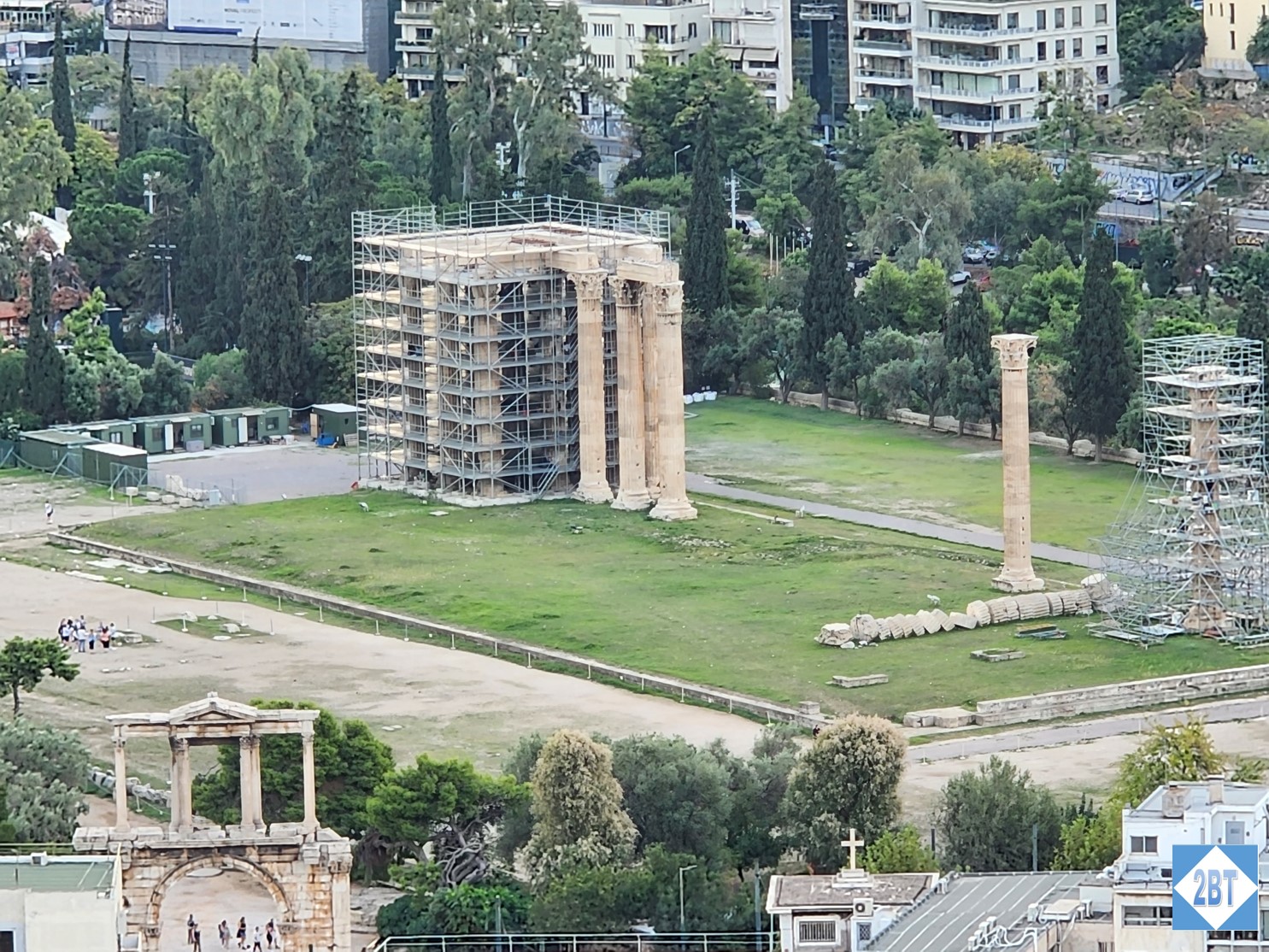
Temple of Zeus with Hadrian’s Arch
Acropolis Museum
The museum ticket is separate from admission to the Acropolis itself or from the combo ticket we had, but it was well worth the extra cost. Tickets were €10 and you can get an audio guide for an additional €5. This is a modern museum, opened in 2009, and is easy to navigate. It is completely accessible for the mobility-challenged and a great way to see many of the original sculptures, friezes, pediments and metopes up close. On the top floor there’s also a short film that runs continuously and alternates narration in English and Greek with English subtitles.
Here are a few things I found interesting:
View from the Top Floor
There’s a lovely view of the Parthenon from the top floor, where the metopes are.
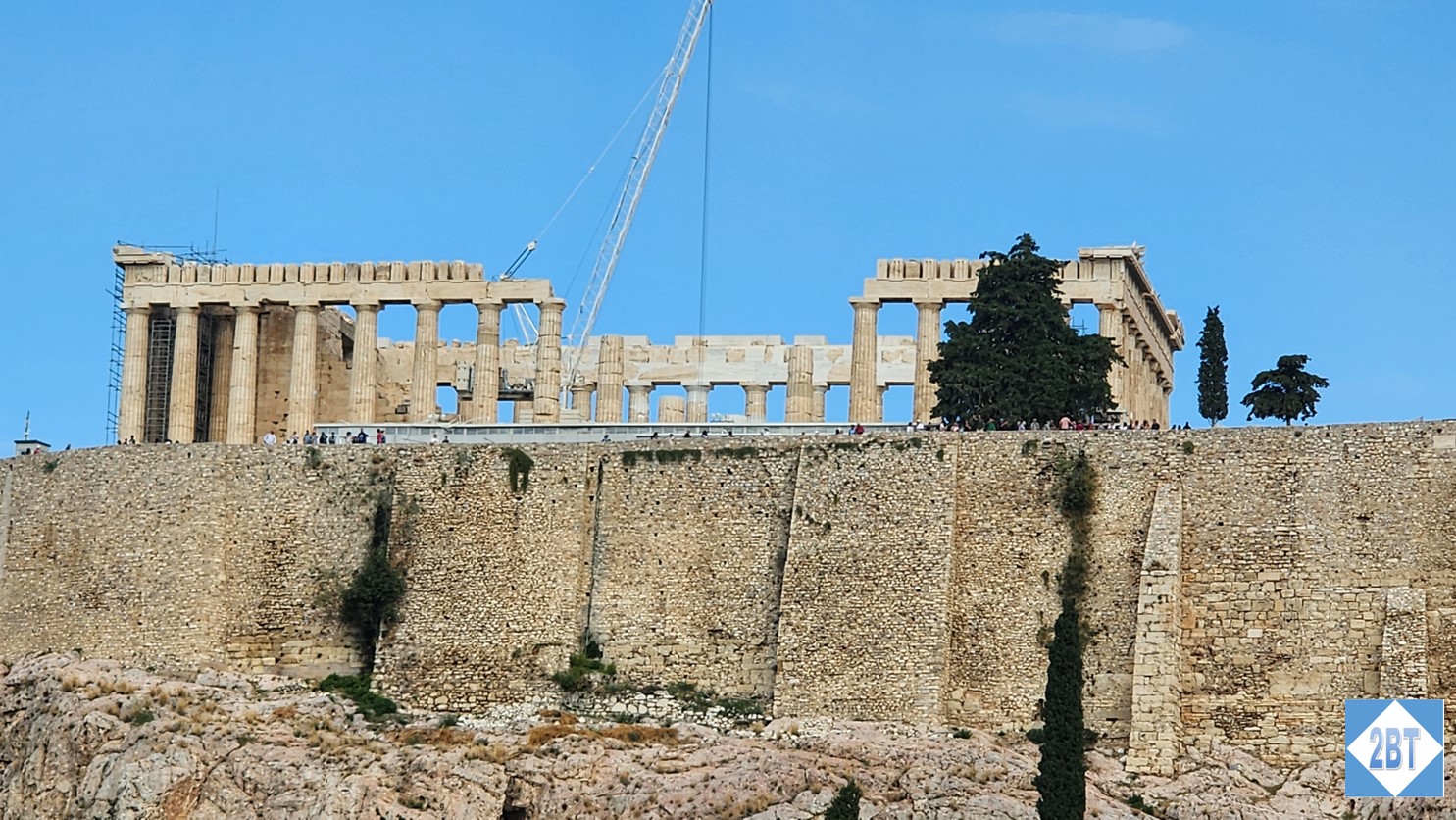
View from the top floor
The Caryatids
Five of the original statues are in the museum, close enough to touch. Their name comes from the Greek work “karyatides” or “maidens of Karyai” which is an ancient town on the Peloponnese. The sixth statue was taken by Lord Elgin in a move that severely damaged the Erechtheion.

The Caryatids from the ground floor
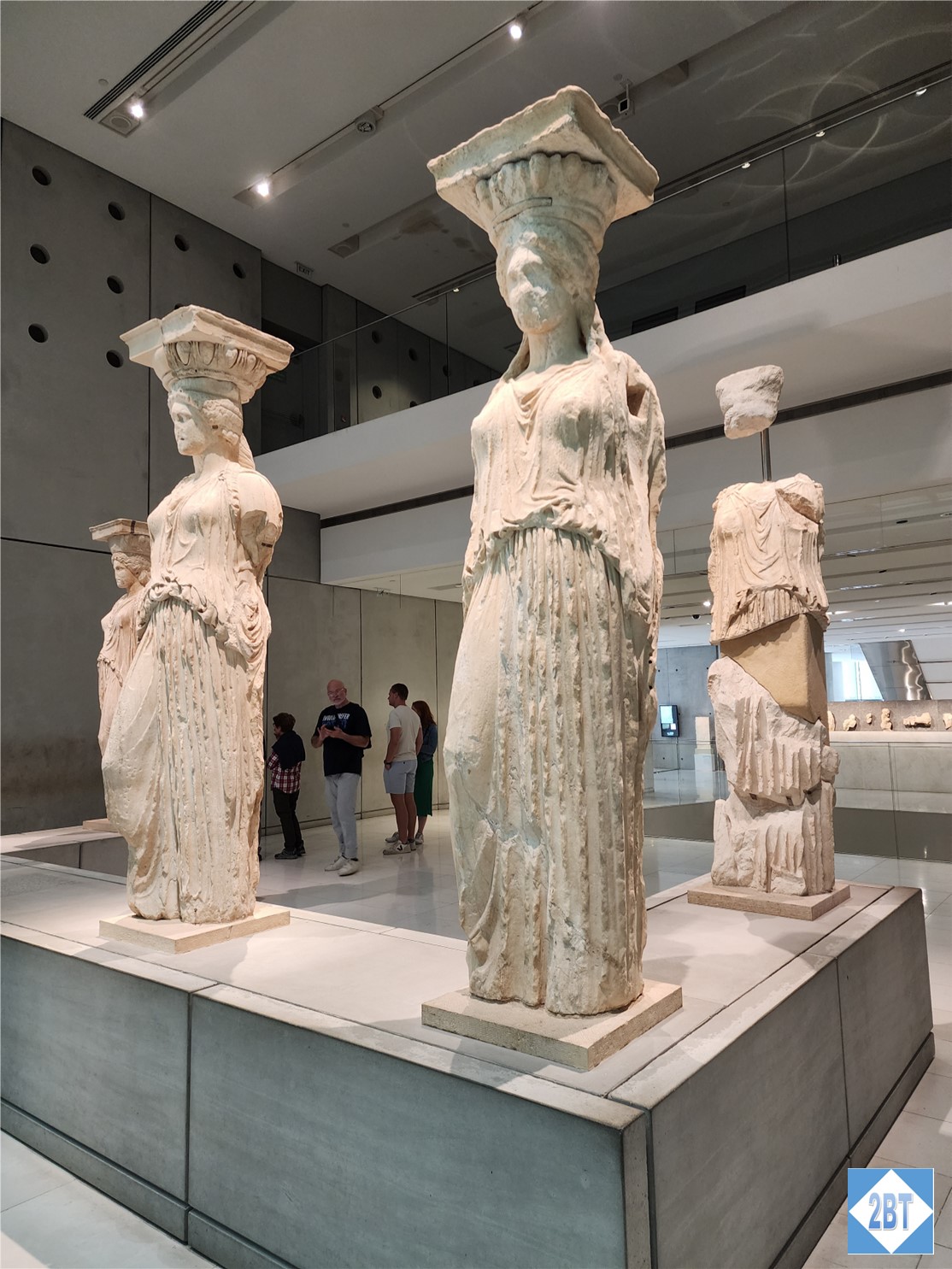
The Caryatids up close
The Cafe
There is a cafe on the top floor with both indoor seating and a covered patio that looks up at the Acropolis. The food is nothing special but it was a lovely day and we had an excellent view.
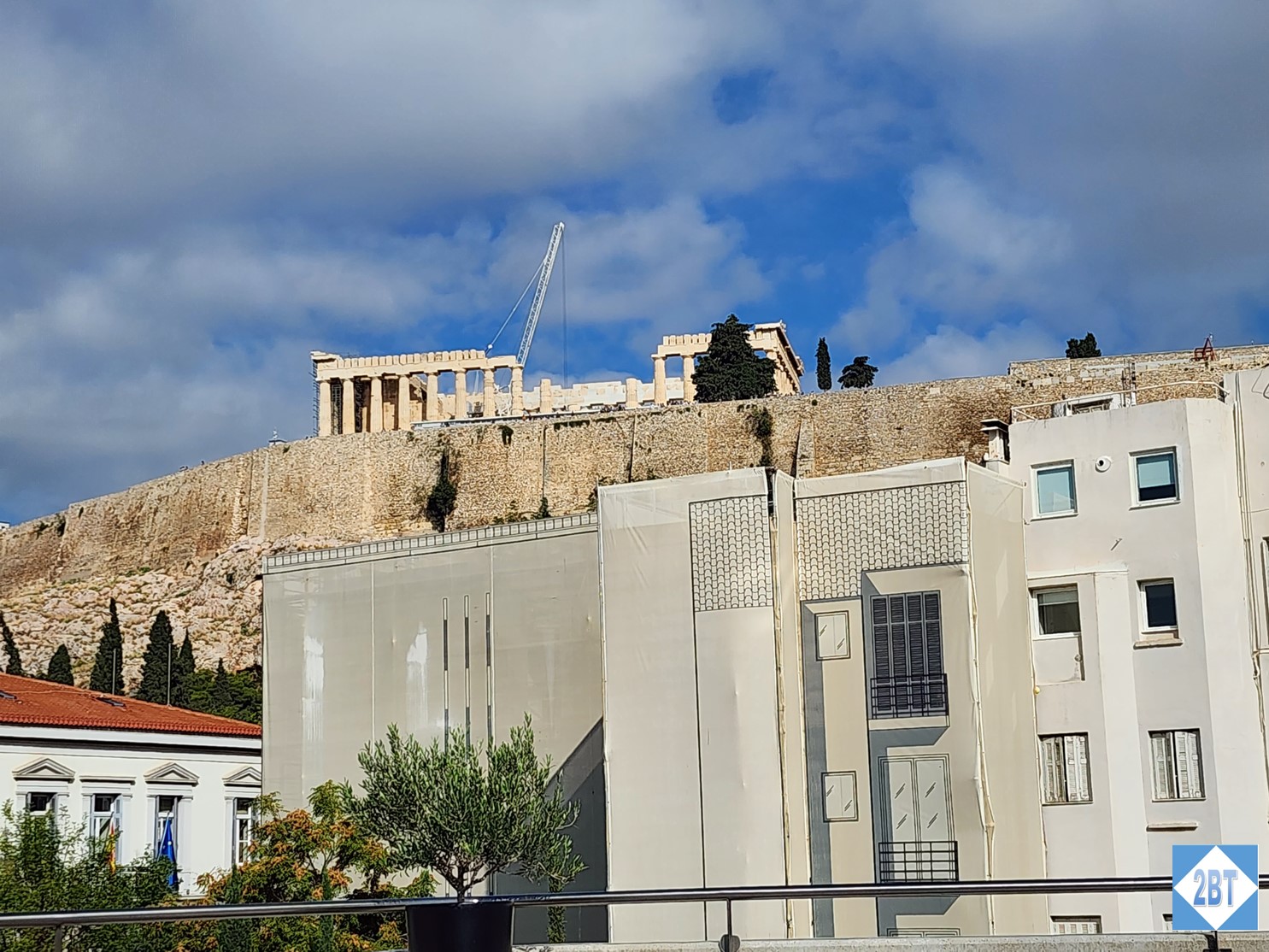
View from the cafe patio
Underground
When you exit the museum, you’re not done yet! Underneath the main floor are several archaeological sites. You can look over the rails and through clear floor panels on the bridge that approaches the museum entrance. Once you have your ticket you can take the path to the left of the museum entrance (as you’re departing) and it wanders down to that level. Then use your ticket to go through the turnstiles where you can see the dig areas up close. While no one was actively digging while we were there, we could see equipment and staging areas where archeologists might work more closely with items they uncovered.
In the end
We had a very busy first morning in Athens with views of the Acropolis from all sides both at street level and on its own level. It is the most famous site in Athens and definitely well worth the effort to visit.

 2B Traveling
Recent Comments