Trip Report: Athens and a Mediterranean Cruise
Lounge Reviews: The Club CLT and Centurion Lounge Charlotte Airport
Flight Review: Lufthansa A340-600 Charlotte-Munich
Lodging Review: Academias Hotel, Autograph Collection, Athens
Our Time in Athens, Part I (Acropolis and Museum)
Our Time in Athens, Part II (Roman Agora, Hadrian’s Library, Ancient Agora)
Our Time in Athens, Part III (Kerameikos, Temple of Zeus, Panathenaic Stadium)
Our Time in Athens, Part IV (Restaurants and Observations)
Ship Review: Viking Neptune
Our Time in Ancient Olympia (Katakalon, Greece)
Our Time in Corfu, Greece
Our Time in Kotor, Montenegro
Our Time in Dubrovnik, Croatia
Our Time in Zadar, Croatia
Our Time in Venice, Italy
Flight Review: Iberia A330-300 Madrid-Chicago
As is usual on Viking cruises, they try to sell you on another cruise while you’re on the current one, offering special incentives to do so. My friends and I have a system for selecting our international vacations: whoever has a birthday ending in a 5 or 0 gets to pick the destination. That covers six out of every 10 years, so it works for us. 2025 is my choice and I’d had my eye on Viking’s Passage to Eastern Europe river cruise which runs between Budapest, Hungary and Bucharest, Romania. When we checked with the on-board travel consultant we learned that we could book this cruise for just $25 down and it didn’t have to be paid off until six months before the sailing. That was huge for me as normally the cruises have to be paid off in 2-3 months. So we went ahead and booked this cruise for $25 and that gave us 18 months to pay. When we added in our past-traveler discounts and our on-board booking discounts, that took another $600 off the price. Plus we got shipboard credit for our current cruise and additional shipboard credit for the one we’d just booked. Want to join us? Click on the link at the top of the page for more info.
Since we’d had an overnight port of call in Venice on our previous Mediterranean cruise back in 2008, our original plan was to skip the included tour and just wander around ourselves. That was something we’d really enjoyed doing the first time around. But now we had shipboard credit to spend. We could have stuck to the plan and used the credits to cover crew tips and some small purchases but where’s the fun in that? Instead we used it to book The Island and the Abbey tour, which took us to the island of Murano and then to the Church of San Giorgio Maggiore as we’d not visited either of time in our previous time in the area.
Murano
Murano is actually a series of islands on the north side of what I think of as “Venice”, which is the island with Piazza San Marco and the Doge’s Palace. In 1291, all glassmakers were required by law to move to Murano, due to the fire hazard that the furnaces presented. At the time, Murano was a summer resort for the aristocracy and glassmakers did not work during the summer break due to the heat and they performed maintenance on their furnaces. Glassmakers were not allowed to even leave the island! But their skill proved to heighten their status and eventually their children were recognized as nobles and allowed to marry into the nobility.
Naturally, the first stop on our tour was to a glass-making business where we were treated to a private demonstration. It was amazing how quickly the lump of molten glass could become a recognizable object!
Thanks to the folks at Ferro & Lazzarini for the demonstration and the display area with so many lovely items. It was hard to choose just one to bring home!
Building Bridges
As we went around the east end of Venice proper, we passed this art installation called Building Bridges, which features six sets of arms/hands, bridging a gap to promote unity. It was created by Lorenzo Quinn, son of actor Anthony Quinn. He describes it this way:
Venice is the city of bridges. It is the perfect location to spread a message of world unity and peace so that more of us around the world build bridges with others rather than walls and barriers.

Building Bridges by Lorenzo Quinn
You can read more about this project here.
Piazza San Marco
When we docked in the small marina beside San Giorgio Maggiore, we stepped onto the plaza in front of the church which gave us a lovely view of Piazza San Marco across the lagoon. The 323-foot campanile is a 1912 reconstruction of a belltower that has been around in one form or another for a thousand years. Beside it is the Doge’s Palace, one of the main landmarks of Venice, which was built in 1340 and modified in the centuries that followed. On the right side of the Doge’s Palace is the Bridge of Sighs. Lord Byron gave it this name based on a translation of the Italian phrase “ponte dei sospiri”, suggesting that prisoners would sigh at their last view of Venice before being taken to their cell.
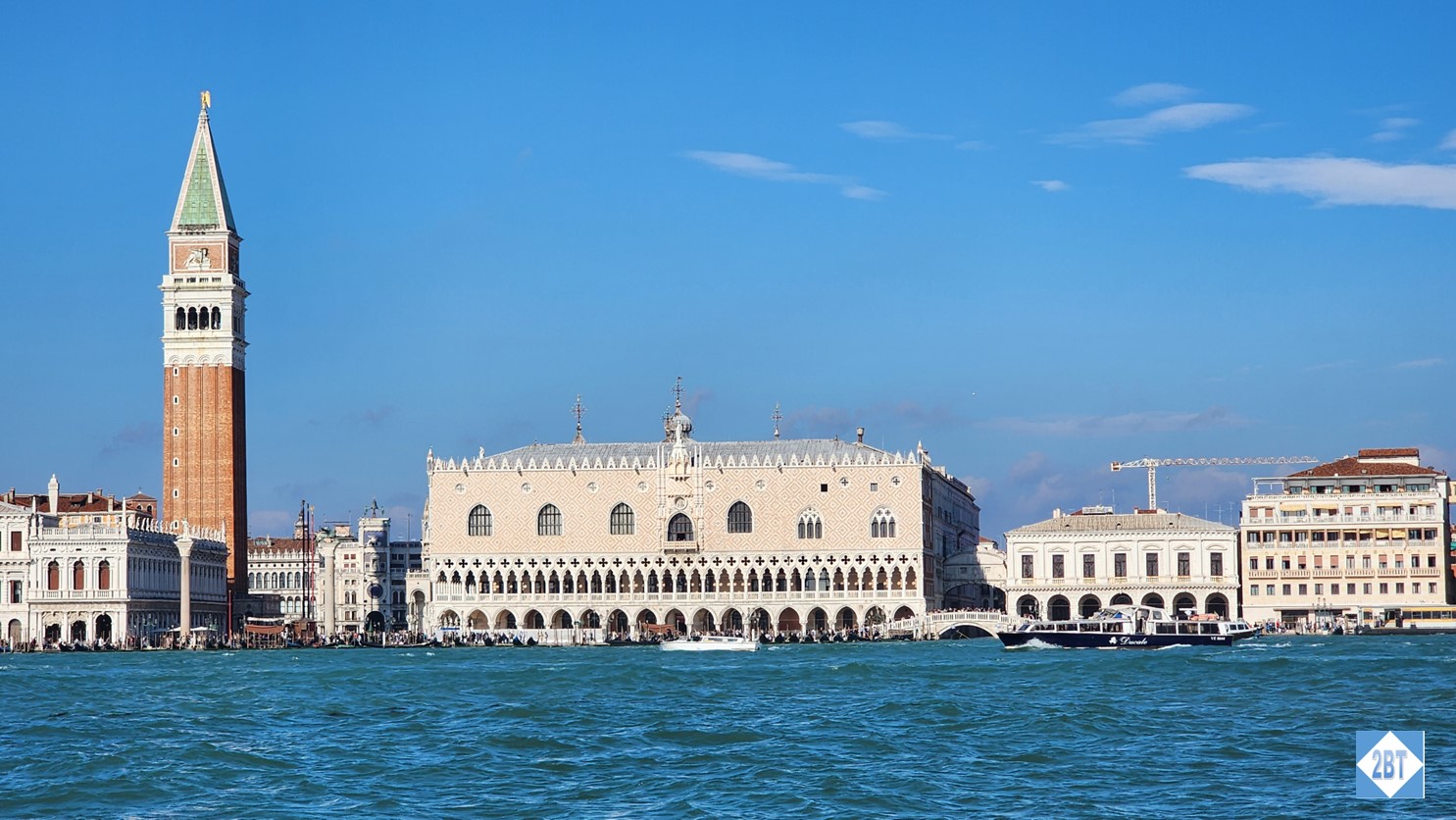
Piazza San Marco with the campanile, the Doge’s Palace and the Bridge of Sighs
Church of San Giorgio Maggiore
Our final stop was this 16th-century Benedictine church, built 1566-1610. A church has been on this island since about 790 and the island itself was given to the Benedictines in 982. All buildings on the island were destroyed in a 1223 earthquake.

Church of San Giorgio Maggiore


Art installation representing the crown of thorns
The church is home to two very large paintings by Tintoretto, one showing The Last Supper and the other, called The Jews in the Desert, shows the Israelites eating the manna that God caused to appear each night as they wandered in the desert.

The Last Supper by Tintoretto

The Jews in the Desert by Tintoretto
In a back gallery was the original angel that sat atop the church.
Back to Chioggia
As mentioned in the prior post, our ship was actually docked in Chioggia so it took us the better part of an hour each way to get to and from the ship. But while the morning had been overcast and extremely breezy, by the time we reached Murano the sun had come out and we had a gorgeous rest of the day. It was fun to see some of the brightly decorated buildings on the way back to the ship.
In the end
This was not a typical visit to Venice but we got to see some things we’d missed on our last visit. October is a great time of year to visit this city and I am impressed at how the barriers in the lagoon can keep flooding to a minimum. I’m happy to go back and visit Venice anytime.
 2B Traveling
Recent Comments